
| The new Superboy was created by Karl Kesel and Tom Grummet and first appeared in Adventures of Superman #500 (June, 1993). |


|
Real Name:
Kon-El (name given by Superman)
Alter Ego: Carl Krummett (undercover identity) Occupation: Cadmus field agent, adventurer, home student Marital Status: Single Known Relatives: Cloned from Paul Westfield; DNA restructured by Roxy Leech’s genetic pattern Age : 1, appears physically 16 Height: 5’7″ Weight: 150 lbs Hair: Black Eyes: Blue Group Affiliations: Project CADMUS, Guardian, Team Superman (Steel, Supergirl and Superman), Young Justice (Robin, Impulse, Wonder Girl, Arrowette, Secret), The Ravers; Legion of Super-Heroes (honorary member); formerly Justice League America Overview: Superboy was one of the four costumed figures who claimed to be Superman after the Man of Steel had been killed by the creature known as Doomsday. Believing himself to be a clone of Superman, Superboy escaped from Project Cadmus with the help of the Newsboy Legion and attempted to pick up where Superman had left off. The Metropolis Kid did his best to protect his adopted city, until the real Superman returned. |
Superman, allied with Superboy, Supergirl, Green Lantern, Steel, and the Eradicator (the last two of whom also having claimed to be the Man of Steel), destroyed Engine City, a massive device
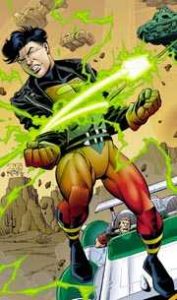 of destruction, formed from in the wreckage of Coast City. Superboy finest hour came when he saved Metropolis from destruction at the hands of Mongul and the Cyborg Superman (Hank Henshaw), when a missle launched from Engine City was to strike Metropolis. Shortly thereafter, Superboy learned that he was not, in fact, a clone of Superman, but of the director of the Cadmus Project, Paul Westfield.
Known Super Powers:
Superboy possesses only one real superpower which he calls “tactile telekinesis”. Somewhat of a misnomer since it acts as more than mere telekinesis, rather the psionic version of a swiss army knife. As long as Superboy is touching an object he is able to affect it with his telekinesis. This allows him to perform a variety of effects:
of destruction, formed from in the wreckage of Coast City. Superboy finest hour came when he saved Metropolis from destruction at the hands of Mongul and the Cyborg Superman (Hank Henshaw), when a missle launched from Engine City was to strike Metropolis. Shortly thereafter, Superboy learned that he was not, in fact, a clone of Superman, but of the director of the Cadmus Project, Paul Westfield.
Known Super Powers:
Superboy possesses only one real superpower which he calls “tactile telekinesis”. Somewhat of a misnomer since it acts as more than mere telekinesis, rather the psionic version of a swiss army knife. As long as Superboy is touching an object he is able to affect it with his telekinesis. This allows him to perform a variety of effects:
Flight: Superboy is able to fly using a reflexive action of his telekinesis, literally dragging himself through the sky. His concentration is required to maintain great speeds. His fastest recorded speed has been seen at Mach 2.94 (viewed from satellite tracking station Gamma 6) and his greatest distance flown unaided has been approximately 12,000 miles. Limited Resistance to Injury: By creating a field around his body, he is able to resist or reduce injury from non-energy based attacks by causing the object to be deflected from his personal force field. Bullets and shrapnel are easily deflected. This field does not repel gases or energy based attacks well, though his skill in deflecting energy attacks is improving.
Telekinetic Disassembly: By touching an object, Superboy may cause that object to literally fall to pieces. It can be assumed that he could conceivably put an object back together, if he understood how the object functioned in the first place. Creating Shockwaves: He may by directing his telekinesis downward create shockwaves through the earth to disrupt his opponents movements or balance. Superboy is gradually being trained by Guardian to improve his use of his single super power by being creative.
Weaknesses: Strangely enough, Superboy is vulnerable to Kryptonite, perhaps for the same reason as his namesake. His body absorbs radiant energy from the sun to fuel his powers and as such Kryptonite is a deadly radioactive material that displaces solar energy in his body, and poisons him by being held within his cells in the place of normal solar energy. Superboy, is not invulnerable to gases or energy based attacks and if his concentration can be affected, he will lose or reduce his effectiveness for the use of his other powers. Strength, Flight and Damage Resistance almost function as intuitive powers but any weapon that attacks his mind could reduce him to being relatively defenseless. NOTE: It is theorized that Superboy’s powers will continue to develop and having learned that a Hypertime version of himself named Black Zero continued to develop further and had more diverse powers with significantly greater control. Black Zero had a psionic version of heat vision, (which could be a form of directed pyrokinesis) and it might be safe to assume that Superboy will develop other powers in time. Unfortunately, his body’s aging process has been arrested due to cellular damage that has been stabilized by the introduction of Roxy Leech’s genetic material. As a result, Superboy does not appear to actually age, but reports of this have not been properly confirmed since a lack of cellular aging and decay would imply a form of virtual immortality. |
|
 Superstrength:
His full strength is undetermined at this time. He, like Superman seems to be able to lift anything he can conceive of. To date he has lifted the worlds largest yacht using his telekinetic strength (a feat of at least 600 tons).) Objects lifted with his telekinetic strength do not crumble under their own weight or internal stresses. It is conceivable as his will power and concentration improve, so will his superstrength increase. This does not truly count as superstrength in the traditional sense, since Superboy has been bound with chains that were surrounded by an energy field and he was unable to escape because he could not directly affect the chains with his power.
Superstrength:
His full strength is undetermined at this time. He, like Superman seems to be able to lift anything he can conceive of. To date he has lifted the worlds largest yacht using his telekinetic strength (a feat of at least 600 tons).) Objects lifted with his telekinetic strength do not crumble under their own weight or internal stresses. It is conceivable as his will power and concentration improve, so will his superstrength increase. This does not truly count as superstrength in the traditional sense, since Superboy has been bound with chains that were surrounded by an energy field and he was unable to escape because he could not directly affect the chains with his power.
 Improved Metabolism:
This may not be a direct affect of his telekinetic aura but without further study it is listed as such. Superboy has a super-healing factor which allows him to recover from injury a lot faster than a normal human being would. This has helped him survive nuclear annihilation, recovering from diseases that would kill normal humans, and the ability to get up after getting fighting powerful metahumans such as Knockout, the Shark or Valor. Superboy’s reflex action is also increased allowing him, with concentration, to knock bullets out of the air, and deflect arrows.
Improved Metabolism:
This may not be a direct affect of his telekinetic aura but without further study it is listed as such. Superboy has a super-healing factor which allows him to recover from injury a lot faster than a normal human being would. This has helped him survive nuclear annihilation, recovering from diseases that would kill normal humans, and the ability to get up after getting fighting powerful metahumans such as Knockout, the Shark or Valor. Superboy’s reflex action is also increased allowing him, with concentration, to knock bullets out of the air, and deflect arrows.
 Weapons:
For a time Superboy wore a eye-visor made by professor Emil Hammilton that gave him Infared Vision, Microscopic Vision, Telescopic Vision, X-Ray Vision, and Heat Vision. This weapon was lost, then used against The Kid, so he destroyed them to prevent anyone from getting hurt if they were ever taken by a villain again.
Weapons:
For a time Superboy wore a eye-visor made by professor Emil Hammilton that gave him Infared Vision, Microscopic Vision, Telescopic Vision, X-Ray Vision, and Heat Vision. This weapon was lost, then used against The Kid, so he destroyed them to prevent anyone from getting hurt if they were ever taken by a villain again.
Kon-El, the clone known as Superboy, represents a fascinating intersection of genetic engineering and superhero legacy. Created as a synthetic replication of Superman's genetic template, his physical abilities mirror many of the Man of Steel's powers while remaining distinct in their limits and expression. His tactile telekinesis grants him a unique form of superhuman strength and flight that operates differently from conventional Kryptonian abilities, allowing him to manipulate objects and his own body through mental control rather than pure muscle power alone.
Despite his young apparent age, Superboy possesses a combat capability that belies his inexperience. His physical power allows him to engage threats far beyond what his teenage appearance would suggest, and his training with the Young Justice team sharpens his instincts and tactical awareness. He has demonstrated remarkable durability and resilience in the field, capable of withstanding impacts and energy attacks that would incapacitate a normal human, while his speed and agility make him a versatile asset in any confrontation.
The clone's origins at Project Cadmus raise complex questions about identity and purpose that define much of his character. Though created from the genetic material of others, Kon-El has forged his own path and sense of self independent of his creators' intentions. His relationship with Superman is layered, evolving from a desire for approval into a more nuanced understanding of what heroism truly means, proving that one's beginning does not dictate one's destiny in the realm of superhuman beings.
Superboy's involvement with Young Justice places him among a new generation of heroes finding their place in a world already populated by established powers. Working alongside other young metahumans, he develops his abilities through practical experience rather than formal instruction, learning through trial and error on real missions. His membership in the group provides him with the camaraderie and support system that his unusual creation otherwise denied him, grounding his extraordinary powers in ordinary human connections.
Within the broader database of metahuman profiles, Superboy stands as a compelling case study of power derived from scientific intervention rather than cosmic or magical forces. His abilities, while considerable, remain grounded in the physical realm, lacking the dimensional or mystical energies that define other entries in the archive. His ongoing development continues to be documented, his current status and capabilities subject to change as he grows into his role, making him one of the more dynamic figures catalogued in the records.